Your basket is empty.
 Free shipping over £159 Open purchase 30 days Fast delivery Customer service 0300-308 60
 Secure payments with Qliro
 B2B LOGIN
Free shipping over £159
Open purchase 30 days
Fast delivery
Customer service 0300-308 60
Secure payments with Qliro
Unloading tools at the service truck and then working a short distance away places different demands on lighting. The light needs to be where you walk and work, even when an open door or the person working risks obscuring a lamp. When choosing work lighting, the placement is therefore just as important to consider as the light pattern. Start with how the car is used during a regular work shift and plan any warning lights as a separate function.

The need for work lights is determined by where the work is being done and what you need to be able to see. The ground behind the car, tools at a side door and a repair inside an engine compartment all place different demands on the placement of the light.
Go through the work steps before deciding on the number of lights. Try using doors, hatches and pull-out drawers in the positions used during work. A light can provide light over a large area but still leave the workpiece in shadow when you stand in front of it.
Also distinguish between permanently mounted lights that illuminate the area around the vehicle and a movable work or inspection light for a specific detail. The fixed lighting does not have to solve every task alone.
A wide beam of light can cover the work area near the car, while detail work may require a dedicated light source that can be directed at the workpiece. Flood is used to describe wide spread; also consider how the light is actually distributed and where the light can be mounted.
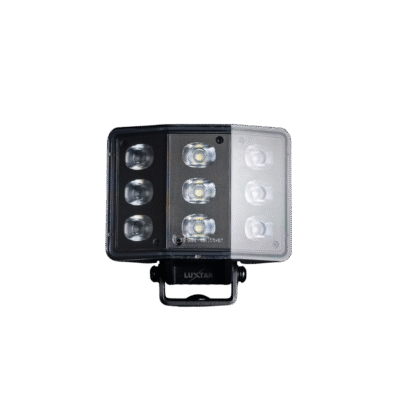
Luxtar Pro Noir WL60 Curved is an example of a fixed work light with a wide flood light pattern. It can be relevant when a larger area is to be illuminated, but the mounting location and working distance need to suit the task. The power rating in the model name alone does not tell how useful the light will be on the work surface.
Direct the light towards the area to be illuminated and check for glare from areas where people stand and move. Also look for reflections in bodywork, glass and shiny equipment. More or brighter lights will not solve an inappropriate placement.
Warning lights are intended to alert others to the vehicle and the current situation. They do not illuminate the work area and do not in themselves create a protected workplace.
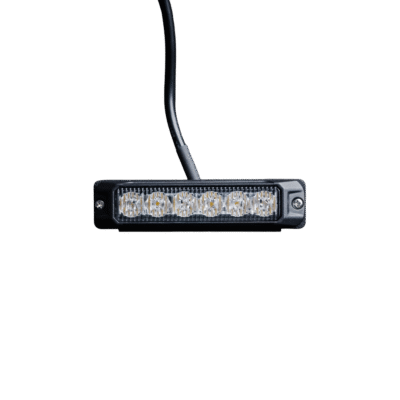
Luxtar OptiFlux is an example of a directional amber warning light with the ability to synchronize multiple units. Placement and adjustment needs to be planned for the entire vehicle. For example, check if open doors, cargo or other equipment obscure the light from any direction.
An approval for a lamp does not alone determine when it may be used. The Swedish Transport Agency rules on the use of warning lights limits use to specified situations where the vehicle may constitute an obstacle or danger to other traffic. Therefore, check the use and installation for the specific work. An additional function with a fixed light should not automatically be treated as an alternative to the approved warning function.
The lighting needs to work with the car in its actual working condition. Test the functions individually and together, with the doors and hatches that are usually open and with the equipment placed where it is used.
As a planning example, a service vehicle may need fixed lighting at the rear doors for loading and a movable light for working in an engine compartment. In this case, check whether the ground, tools and the workpiece itself are visible without the body or a door obscuring the light. The location of the warning light is assessed separately based on where the vehicle is located and which traffic directions need attention.
Voltage range, current requirements, wiring, fuses and mounting must match the vehicle and product instructions. Also plan how long the lighting will be used when the engine is off and how the power supply will handle it.
When you can describe the work areas, vehicle and application, it will be easier to choose the right products. Include this information when you contacts Xenonkungen for help with the selection.
For companies and workshops
Do you shop for the company?
With a business account you get invoice payment, volume discounts and your own contact person.