Your basket is empty.
 Free shipping over £159 Open purchase 30 days Fast delivery Customer service 0300-308 60
 Secure payments with Qliro
 B2B LOGIN
Free shipping over £159
Open purchase 30 days
Fast delivery
Customer service 0300-308 60
Secure payments with Qliro
Do you want better light on dark roads? The first question is when you lack it. Is it when you meet other cars and drive on low beams, or when you have the high beams on on a dark country road? The answer determines whether you need to review your car's existing lights or supplement with extra lights. In this guide, we go through what you need to check and how to choose between LED ramps and round extra lights based on your driving and the car you have.

If you are particularly blind when the high beams are dimmed, you need to start with the low beams. Auxiliary lights reinforce the high beams and therefore do not help during the parts of the journey where you need to drive on low beams.
Check that the headlights are clean, that the bulbs are working and that the light setting is correct before choosing new products. A damaged headlight or incorrect setting needs to be fixed; a brighter light source will not automatically solve the underlying problem. Follow the vehicle's instructions and seek help from a workshop if the light is uneven or seems misdirected.
Halogen, xenon and LED are different lighting technologies, and the replacement needs to work with the car's headlights and drive system. When comparing lamps for low beam and high beam you therefore need to know the car's lighting design. The socket guide will help you find out which lamp fits the car.
Changing from halogen to LED requires more control than just the same socket designation. Fit, accessories and approved use need to be correct for the product and the car in question. For OSRAM replacement lamps, there is instructions for checking the LED conversion. Please refer to the documentation for the exact lamp; the conditions are not the same for all products.
Both an LED ramp and separate round lights are additional lights that complement the high beam. The choice is about how the light is distributed, what mounting options the car has and what design you want in the front.
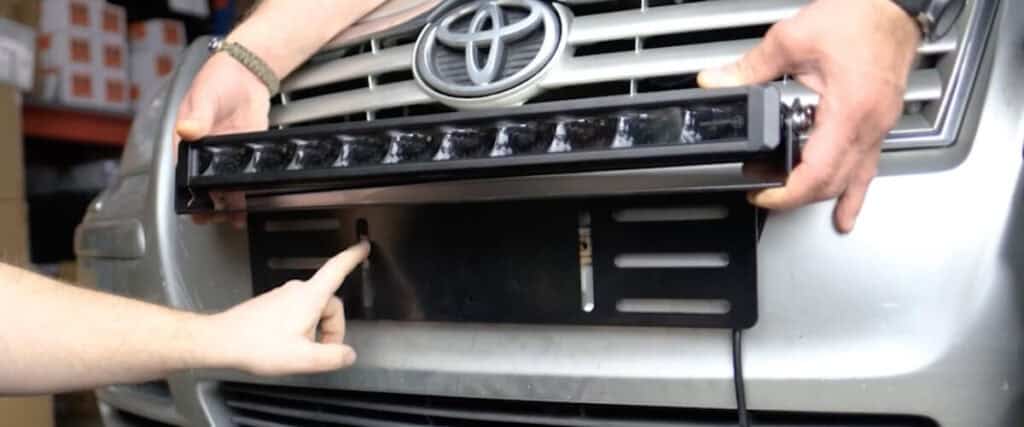
An oblong ramp needs space in width, while several round lanterns need space for both the lamp housing and brackets. Therefore, compare LED light bars and round driving lights with the dimensions of the car in front of you. The shape alone does not determine whether you get the most width or the longest reach.
Luxtar Twilight has an oblong lamp housing that is 45 mm high according to the product dimensions, while Luxtar Stellar Dynamic 9 inch is a round auxiliary light. Both are specified with Driving light pattern. They show why you need to assess the format and light pattern separately and also take into account the space that the attachment requires.
LED and xenon also exist as different technologies in auxiliary lights. Keep that choice separate from replacing the xenon bulb in the car's original headlights. They are different products and installations, even though the same technology name is used.
On a winding country road you need to be able to follow both the road and its edges, while long straight stretches also place demands on the light further ahead. Therefore, look at the entire light pattern instead of choosing only based on the longest stated range.
Spot usually refers to a more concentrated light pattern and flood to a wider spread. Driving and combo are used for light patterns that combine length and width, but the terms do not describe the exact same distribution for each model. Ask for light patterns or measurements for the lamps you are comparing.
Lumen indicates the luminous flux from the lamp, while lux describes the illuminance on a surface. A statement of, for example, 1 lux at a certain distance therefore needs to be read together with the width and distribution of the light. It does not say that the entire lane is equally well lit at that distance.
Compare range at the same lux level and for the operating mode you are going to use. If a product has both an approved mode and boost, the data should be kept separate. Kelvin describes the color temperature of the light and is not a measure of how far the lamp shines.
Measure the space for the lamp housing, brackets and connections and check the car's instructions for placement. Take into account, for example, radar, parking sensors and other functions in the front. A product that fits in a photo may not fit the equipment variant that your car has.
The connection requires both a signal that controls the auxiliary light and a power supply that is sized for the installation. Check how the high beam signal can be obtained from your particular car and whether the chosen solution supports the car's equipment.
In our guide to installing additional lights The difference between control signal and supply is explained and what you need to check before connecting. With automatic or adaptive high beam, the auxiliary light's activation and dimming also need to work with the car's system.
Check the product approval for the function and operating mode you intend to use and follow the instructions for assembly and use. For questions about when different lights may be on at the same time, see The Swedish Transport Agency's information about vehicle lighting.
If you are unloading tools or working next to your car, you need lighting for the work area. This is a different task than amplifying the high beam while driving. In the guide about work lights for the service vehicle We will go through placement, shading and how any warning lights have their own function.
Please describe where you drive, what light you want to improve and what car and equipment you have when you Contact Xenonkungen for help with the selection. Then you can assess the products based on your driving and the car's conditions.
Installed and Ready
Would you rather have a workshop install it?
Buy extra lights with installation, and one of our partner workshops will install them for you. Installation has a fixed price and is booked when you shop.